ESH MASTER plan

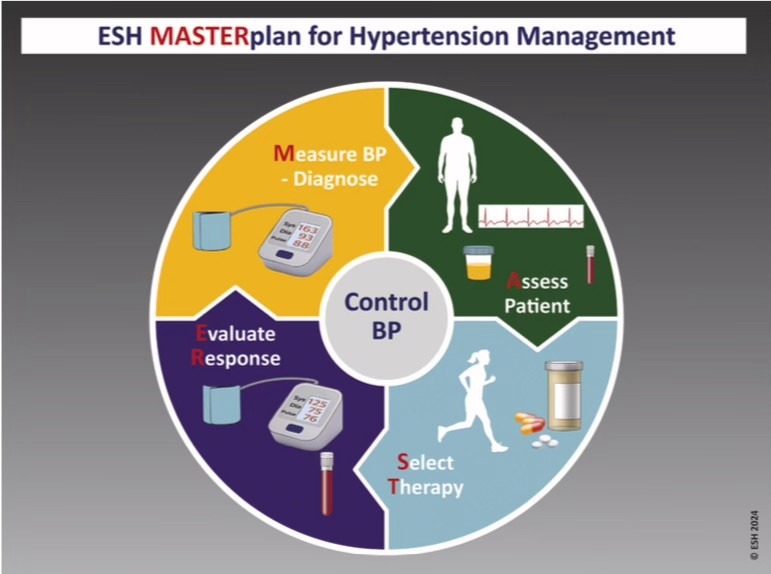
ESH MASTER plan for the management of hypertension

The European Society of Hypertension (ESH) released a comprehensive 200-page document in 2023 detailing guidelines for managing arterial hypertension. To make these guidelines more accessible for healthcare providers, the ESH has introduced a concise version in 2024, called the MASTER plan, which highlights key points for easier implementation in clinical practice.

M

Measure Blood Pressure – Diagnose: Accurate BP measurement is essential for diagnosing and managing hypertension and is the first critical step in the ESH MASTERplan for hypertension management.

A

Assess – A comprehensive patient work-up collects key details about personal and medical history, relevant factors, and co-morbidities affecting BP, cardiovascular risk, and management, guiding the choice of treatment and follow-up strategy.

ST

Select Therapy – Lifestyle interventions reduce BP, improve cardiovascular health, and lower the risk of chronic diseases. They may control BP alone in patients with mildly elevated grade 1 hypertension and low risk, but most require both lifestyle changes and medication to achieve control within three months based on individual risks. The main BP-lowering drug classes include ACE inhibitors, ARBs, beta-blockers, calcium channel blockers, and thiazide diuretics. Additional treatments are for patients with resistant hypertension, heart failure, or CKD, and renal denervation may be considered for resistant hypertension or uncontrolled BP despite combination therapy, or when drug treatment causes serious side effects (if eGFR > 40 ml/min/1.73m²).
ER

Evaluate Response – Regular evaluation of BP response after treatment initiation (3 months), and during short- and long-term follow-up, is essential to monitor effectiveness and adjust therapy. The goal is to first achieve BP below 140/80 mmHg, then optimal individual targets. Monitoring for side effects, eGFR, potassium levels, and changes in risk factors or co-morbidities is also crucial.

References:

European Journal of Internal Medicine. (n.d.). https://www.ejinme.com/article/S0953-6205(24)00238-3/fulltext

Related Posts

Scroll to Top